
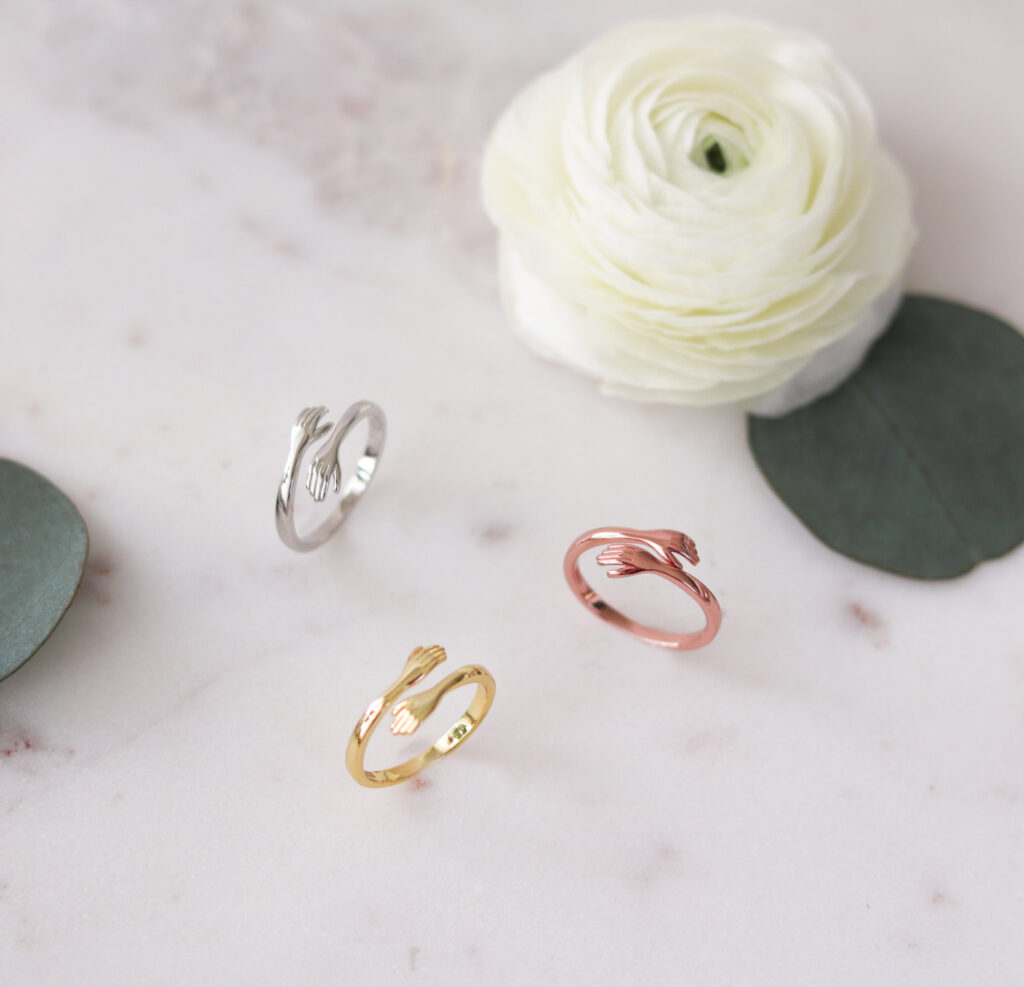
The hug ring is a piece of jewelry shaped like two clasped hands, a symbol of an embrace that distance cannot erase. In Canada, it has become a favourite gift for those who want to say “I am here, even when I cannot be.” Beneath its quiet design lies a story nearly two thousand years old, a meaning shared across cultures, and an emotional weight that touches friendship as much as grief. Here is everything that makes this small ring a piece apart.
The essentials
- The hug ring is a band featuring two clasped hands, a universal symbol of embraces, love and support.
- Its motif goes back to Roman antiquity and has traveled through every major tradition of Western jewelry, from the Middle Ages to the Victorian era.
- It is offered in meaningful moments: distance, grief, a birth, the end of a chapter, or simply to say “I am thinking of you.”
- The most durable models are made of sterling silver 925 or 10K or 14K gold, and are generally adjustable and hypoallergenic.
- In Canada, it has also become a discreet keepsake worn in memory of a loved one, or to honor a bond someone wants to keep alive.
What is a hug ring?
The hug ring is a band featuring a central motif of two hands embracing around the finger, acting as a miniature, permanently horn hug. This design is neither a passing trend nor a sentimental gimmick. It is part of a jewelry tradition that has materialized human bonds for centuries.
A ring shaped like two clasped hands
The design is almost always the same: two stylized hands, sculpted in silver or gold, meeting to encircle the finger. The motif of two joined hands is one of the oldest relational symbols in Western jewelry, and it has a name: the fede, from the Italian mani in fede, meaning “hands in faith.”
From the Romans to the Claddagh: a symbol nearly 2,000 years old
The gesture of joining hands to seal a bond goes back to Roman antiquity, where it was known as dextrarum iunctio (“the joining of right hands”). It stood for conjugal fidelity and appeared on wedding rings as early as the third century. The Victoria and Albert Museum in London holds several Roman intaglios showing this motif.
After a few centuries of silence, the motif reappeared in Europe in the 12th century, codified by Italian goldsmiths as the fede ring. The British Museum holds several medieval and Renaissance examples, including a 16th-century gold gimmel-ring whose two interlocking bands reveal a heart when opened. In the 17th century, this visual language inspired the famous Irish Claddagh ring, which added a heart and a crown between the two hands. The step from the Claddagh to the contemporary hug ring is not a cultural leap. It is the same visual grammar, simplified for today’s sensibility.
When clasped hands also speak of absence: the Victorian tradition
In the 19th century, Victorian England developed a unique tradition: mourning jewelry, worn by bereaved families during the formal periods of mourning prescribed by social etiquette. One of the most common motifs in these keepsake pieces was precisely that of clasped hands.
Its meaning then carried two layers. Depending on the context, the joined hands could represent the farewell between the living and the dead, or the reunion hoped for in the afterlife. The same gesture could say “I love you” to a future spouse or “I have not forgotten you” to a loved one who had passed. The contemporary hug ring carries this dual lineage: the Roman and medieval fede, a symbol of living love, and Victorian mourning jewelry, a symbol of memory and continued presence in spite of absence.
The meaning of the hug ring: far more than a piece of jewelry
The hug ring carries a simple but layered message: I care, I am here, I keep loving you. Depending on the moment in which it is offered, it can symbolize family love, lasting friendship, support through a hard chapter, or the memory of a loved one. This versatility is precisely what sets it apart.
A symbol of love, friendship and support
Offering a hug ring means offering an embrace that stays. It suits a mother walking with her daughter through a new chapter as much as a friend marking a deep bond. Many women wear it every day as a quiet reminder that someone, somewhere, loves them.
A source of comfort across distance or absence
For those separated from loved ones by geography, illness or a packed schedule, this piece becomes an anchor. A glance, and the symbolic presence of someone dear comes back to life. Many wearers say they reach for their hug ring in difficult moments, the way you instinctively reach for someone’s hand.
A tangible embrace for those in grief
This is one of the most moving dimensions of this piece. The hug ring is increasingly worn in memory of a loved one, whether a parent, a child or a companion. It replaces nothing, of course, but it gives an object to rest your fingers on when sorrow surfaces. Without the solemnity of a traditional funeral piece, it opens a softer, more everyday space to carry someone’s memory.
Physical contact, a fundamental human need
Physical contact shapes human bonds from the very first moments of life. According to the Canadian Paediatric Society, skin-to-skin care between a parent and a newborn supports early bonding (also called attachment), helps stabilize the baby’s body temperature, breathing and heart rate, and contributes to relational health and well-being. The hug ring does not replace real contact, but it belongs to the same concept: a presence made tangible.
Who is a hug ring for?
There is no single right answer. The hug ring suits any relationship in which you want to leave lasting tenderness. Here are the situations we see most often at La Joie en Rose.
To a mother, a daughter, a sister
This is one of the most popular choices in Canada, especially around Mother’s Day, a birthday or a major life passage (leaving for university, a wedding, a first pregnancy, or grief).
To a close friend, near or far
To celebrate a friendship that has stood the test of time, or to walk alongside a friend who is moving away, the hug ring stands in for the words that are hard to find. It says «I am here», without needing anything more.
In memory of a loved one
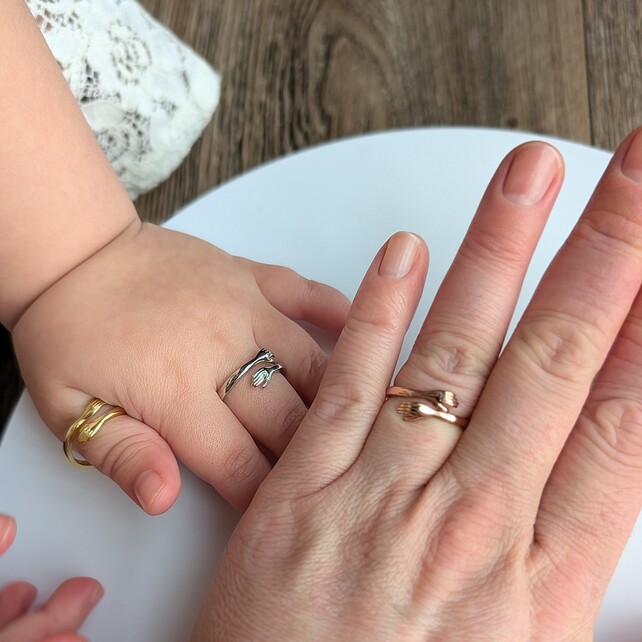
Many women wear it in memory of a mother, a grandmother or a child. The gesture is one of choosing a piece they will wear for themselves, the way you keep a precious memento close.
To yourself, as a gesture of self-love
More discreet but steadily growing, buying one for yourself is a quiet act of comfort, often after a breakup, a loss or simply a difficult stretch. The hug ring then becomes a daily reminder that tenderness can also come from within.
How to choose your hug ring
The choice comes down to three main criteria: material, fit and personalization. These three elements shape both the durability of the piece and the emotional weight it will carry.
The material: sterling silver, gold or plated
Sterling silver 925 is the most common choice: durable, hypoallergenic and affordable. 10K or 14K gold (yellow, white or rose) offers greater longevity and suits those who wear their ring at all times, including in the shower. Plated models are more accessible, but their finish fades with time.
An adjustable ring that fits every hand
Most hug rings are designed as open bands, which means you can gently tighten or loosen them. This is a real advantage when buying a gift: you do not need to know the exact ring size of the person receiving it.
Personalization: birthstone, engraving or integrated symbol
Many jewelers offer personalization options: adding a birthstone, engraving a name or a date, choosing a finish (yellow, white or rose gold). This is what turns a beautiful piece into a unique one, deeply tied to a person or a relationship.
A hug ring by La Joie en Rose
At La Joie en Rose, we offer the Love and Friendship Hug Ring, available in sterling silver and in 10K or 14K gold (yellow, white or rose). Each model is adjustable, available in every size, and can be personalized with a birthstone to turn it into a truly one-of-a-kind piece.
Whether you want to walk alongside a friend, honour a mother, mark the end of a breastfeeding journey or carry the memory of a loved one, this piece reflects the mission that has guided our family business from the start: turning a precious bond into a treasured keepsake.
Frequently asked questions about the hug ring
It symbolizes a permanent embrace and stands for love, friendship, support and remembrance. It is a piece you offer to say that you remain close, in spite of distance or absence.
There is no rule. Most wearers choose the ring finger, the middle finger or the index of the non-dominant hand. Some pick a specific finger tied to the person they wish to keep close.
A ring in solid sterling silver or gold handles water without issue. Gold-plated or rose-gold-plated models wear down faster with repeated contact with water and soaps.
Gently press on the body of the band to tighten or widen it, never directly on the sculpted hands, which are more delicate. The adjustment should be made once or twice at most, to protect the metal.
Yes, this is something we see often at La Joie en Rose. It offers a soft, everyday piece to wear in memory of a loved one, without the solemnity of a traditional funeral piece.
Comments are closed for this article!