
Combination feeding blends breastfeeding at the breast with bottles. More and more Quebec mothers choose this approach to balance a return to work, fatigue, or simply a need for more flexibility. With the right support, it lets you continue breastfeeding at your own pace, without pressure or guesswork.
Key takeaways
- Combo feeding blends breastfeeding at the breast with bottles of breast milk or formula, also called mixed feeding.
- Health professionals generally recommend waiting until breastfeeding is well established, usually around 4 to 6 weeks, before introducing a bottle.
- In Quebec, 66% of babies were breastfed during their first four months of life in 2020 to 2021, up from 41% in 1997 to 1998.
- Breast milk and formula should not be mixed together in the same bottle.
- Resources like Nourri-Source and IBCLC-certified lactation consultants are available in Quebec to support you every step of the way.
What is combination feeding
Combination feeding means feeding a baby both at the breast and by bottle, whether that bottle contains expressed breast milk or infant formula. It is also known as mixed feeding or partial breastfeeding. Unlike exclusive breastfeeding, it does not require breast milk to be the baby’s only source of nutrition.
The balance between breastfeeding and bottles varies enormously from one family to another. Some mothers keep one feed at the breast in the morning and evening, while others alternate throughout the day. There is no single right way to do it.
Why choose combination feeding
The reasons families choose combo feeding are personal, but three situations come up more often than others. Each family’s context shapes the decision differently, and there is no wrong reason to make this choice.
Returning to work
Parental leave comes to an end, and pumping at work is not always simple to organize. Combo feeding lets you keep part of your breastfeeding routine while leaving some feeds to your baby’s caregiver.
Low milk supply or fatigue
Some mothers produce less milk than they would like or simply need a break after demanding weeks. Topping up with a bottle is not a failure. It is a way to preserve breastfeeding rather than stopping it abruptly.
Involving the second parent
Giving a bottle allows the second parent, or another loved one, to feed the baby and build their own bond while giving mom a chance to rest.

When to start combination feeding
This question comes up for nearly every mother considering combination feeding. Most health professionals recommend waiting until breastfeeding is well established before introducing a bottle, generally 4 to 6 weeks after birth. Introducing a bottle too early can reduce stimulation at the breast and, in turn, milk production, since supply responds to demand.
In Quebec, 66% of babies were breastfed, exclusively or not, during their first four months of life in 2020 to 2021. That is up from 41% in 1997 to 1998, according to the Institut de la statistique du Québec (ISQ, November 2024). That growth includes more families who, like you, combine breastfeeding and bottles instead of choosing one.
Every situation is different. A health professional or an IBCLC-certified lactation consultant remains the best person to advise you on the right timing for you, especially if you are considering introducing a bottle earlier.
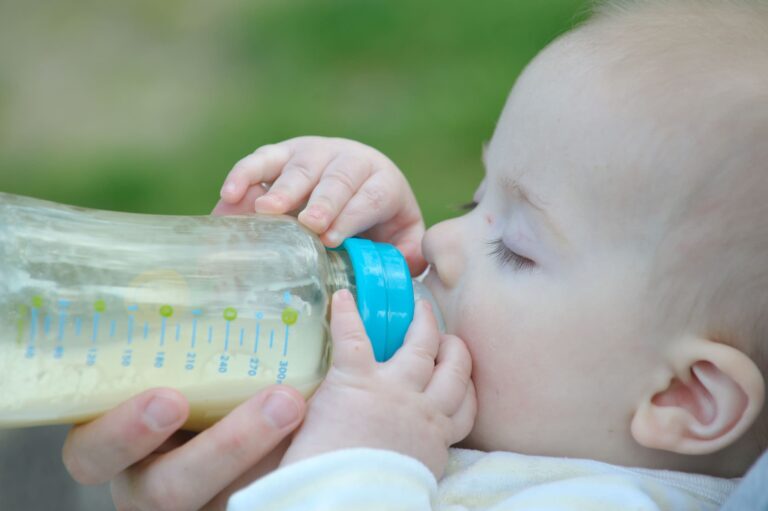
How to introduce the bottle without disrupting breastfeeding
A gentle transition generally rests on two principles shared by breastfeeding professionals: taking it gradually and choosing the right equipment.
Choosing the first feed to replace
Lactation consultants often suggest starting with a single feed, usually the midday one, which tends to be the least abundant. Wait a few days before replacing a second one, if you choose to. Every baby and every milk supply is different, so an IBCLC consultant or a Nourri-Source breastfeeding support volunteer can help you adapt this pace to your reality.
Preventing nipple confusion
The breast and the bottle require different sucking patterns, which explains why some babies develop a preference for one over the other. A slow-flow nipple and a gradual introduction are commonly recommended by breastfeeding professionals to limit this risk. If your baby shows signs of refusing the breast, a resource like Nourri-Source or a lactation consultant can look at the situation with you.
Can you mix breast milk and formula in the same bottle
This practice is generally not recommended, mainly for storage reasons. Breast milk and infant formula follow different storage rules. If your baby does not finish the bottle, the leftover portion must be discarded according to whichever timeframe is shorter, which often wastes precious breast milk. Offering the two separately, in two different bottles, is the approach generally suggested by health professionals.
How to limit a drop in milk supply
A drop in milk supply is common when starting combination feeding, and there are documented ways to limit it.
Pumping regularly
Pumping when you are away from your baby is commonly recommended by lactation consultants to maintain the stimulation your body needs to keep producing milk. Many mothers also use this time to build a frozen stash, handy for unexpected situations.
Recognizing the signs early and asking for help
Breasts that feel less full, or a baby who seems unsatisfied after a feed, are signs worth paying attention to. Rather than trying to manage everything alone, an IBCLC lactation consultant or a Nourri-Source breastfeeding support volunteer can assess your situation and suggest options suited to you. In the meantime, resting well and staying hydrated can only help.
How long does breast milk keep
Storing breast milk safely means following precise rules, whether it is milk expressed for combo feeding or milk kept as a reserve.
Breast milk | Room temperature | Refrigerator | Freezer |
|---|---|---|---|
Freshly expressed | 4 hours (about 26 °C / 79 °F) | Up to 8 days (4 °C / 39 °F) | 6 months (freezer compartment inside the fridge) to 12 months (deep freezer) |
Thawed | 1 hour | 24 hours | Never refreeze
|
These figures come from guidelines published by the Institut national de santé publique du Québec (INSPQ) and Naître et grandir. These durations are not cumulative, and if you are ever unsure, your healthcare provider remains the best resource to consult.
Where to find breastfeeding support in Quebec
You rarely have to navigate combination feeding alone, and several Quebec resources exist to support you with qualified help. La Fédération Nourri-Source connects families with volunteer breastfeeding support helpers across Quebec, offered free of charge. For every piece of breast milk jewelry sold, La Joie en Rose also donates $2 to this federation, a concrete way to support breastfeeding women and families. A certified IBCLC lactation consultant can assess your situation individually, especially useful in case of pain or a marked drop in supply. La Leche League Canada also offers mother-to-mother support by phone or in person.
If you have surplus milk once your combination feeding routine is stable, you can also donate it to the breast milk bank managed by Héma-Québec, under certain conditions.
FAQ: combination feeding
Lactation consultants often suggest trying a different nipple, or having someone apart from mom offer the bottle in a different room. Patience is crucial, as multiple attempts are frequently necessary. If the situation continues, a lactation consultant or a Nourri-Source breastfeeding support volunteer can observe the situation with you.
A health professional can help you choose the best formula by considering your baby’s age, specific needs, and any allergy risks. No single formula is universally better than another.
There is no universal ratio. Many families keep 2 to 3 feeds at the breast per day, topped up with bottles as needed. What matters most is watching your baby’s hunger and fullness cues rather than following a rigid schedule.
In many cases, yes, usually by increasing feed frequency to stimulate supply again. An IBCLC lactation consultant is best placed to support you through this process.
Every situation is different. If you have doubts, especially if you are considering introducing a bottle before 6 weeks, a health professional or lactation consultant can reassure you and adapt the recommendations to your reality.
No. Every feed or bottle of breast milk keeps its benefits, regardless of the proportion compared to formula. Combination feeding is still breastfeeding, period.

Your breastfeeding, your pace
Whether it lasts a few weeks or several months, combo feeding is simply one way to live this chapter with your baby, on your own terms. For many mothers, the moment breastfeeding changes shape, or nears its end, also sparks a wish to keep a tangible trace of it. If that sounds like you, discover how to turn your breast milk into a keepsake jewel, another way to honor a journey that is yours.
$2 per Breast Milk Jewel sold, all models combined, is donated to La Fédération Nourri-Source. A great way to support breastfeeding women and families.



Comments are closed for this article!